Showing posts with label Alexander Mcqueen. Show all posts

Thursday, 3 September 2015

GIVENCHY - TOP 5

Yesterday was a momentous day for the house of Givenchy. Riccardo Tisci took the Internet by storm by announcing that 1200 tickets to the SS2016 presentation would be available to members of the public, a move designed to celebrate both the launch of a New York flagship store last week and the opening of a flagship in Milan which will coincide with the show on September 11th. Givenchy is one of the industry's longest-running fashion houses; founded in 1952 by Hubert de Givenchy, the house quickly gained a reputation for its elegant couture pieces and its sartorial links with icons such as Jackie Kennedy and Audrey Hepburn. The brand has come a long way, recruiting legendary designers such as Alexander McQueen and John Galliano along the road. Since his appointment in 2005, Tisci has nurtured a new, darker aesthetic and catapulted the brand to huge mainstream success. To celebrate his first decade at the house and his decision to make high-fashion more accessible, here are five of Givenchy's greatest collections.
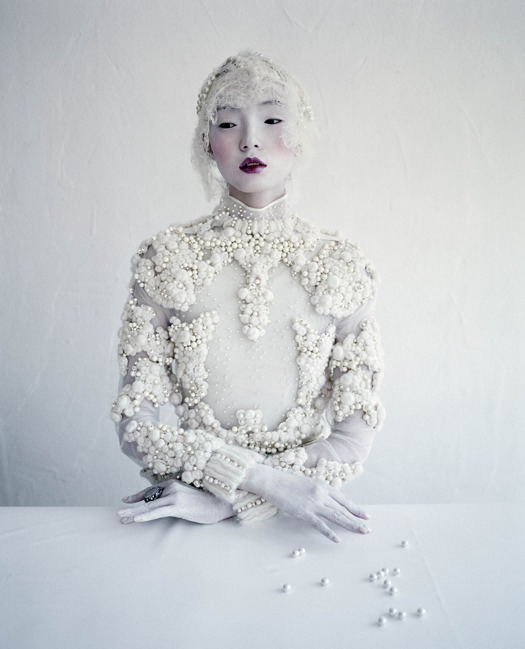
Xiao Wen Ju wearing Givenchy Couture, A/W 2011

Monday, 10 August 2015

DECAY

Despite what sexed-up vampire shows like True Blood try to tell us, there is nothing sexy about death. The cold, grotesque reality of a corpse is something which strikes fear and disgust into the heart of most – it is a cruel reminder of our finite reality, our inevitable end. Fashion, however, mostly conjures up far more pleasant images. From the location-based fantasies of fashion editorial to the luxury fabrics and displays of extravagance shown on the runway, fashion is designed to be aspirational. Gender politics and political issues occasionally get mentioned (mainly thanks to Miuccia and Vivienne), but at its core fashion is an industry built on aspiration. On the whole, we aspire to wealth and to beauty, and the runways reflect these aspirations en masse.


However, in a recent series entitled UGLY, Showstudio launched an investigation into the concept of ugliness and how it can be rendered desirable in the hands of certain mavericks. The series is also designed to explore the various reasons for the social reluctance to accept ugliness – after all, society is informed by its surroundings. The things that we see and associate as ‘ugly’ are not only repulsive to us because of our own life experiences and our own perceptions, but the perceptions of the age in which we grew up. The example that Lou Stoppard cites as being “of our time” is the Harley Street generation, a legion of men and women determined to bleach out any imperfection. We are often told our imperfections are what make us perfect, but in a world of “Human Barbies” and silicone experiments gone wrong, it seems that we are reluctant to listen to this advice. It could be as simple as covering a pimple or as extreme as breast enhancement, the concept remains the same – it is the concept of “self-improvement” which we are shown to be technologically possible in the modern world. Unsurprisingly enough, the importance of hygiene and cleanliness is also related to these examples of aesthetic perfection. Decay, disease, dirtiness – all of these are to be avoided at all costs. Instead, our bodies and faces should be gleaming, free of blemishes, plastic, artificial.


Monday, 3 August 2015

UGLY: McQUEEN

It is often assumed that fashion and beauty are synonymous with one another. Beauty is aspirational, seemingly achievable, and certainly profitable. High-profile designers curate advertisements selling not only a product, but a lifestyle, and men and women alike buy into the fantasy on a daily basis. Fashion rarely explores the grotesque, the ‘ugly’, because it is not profitable and, ultimately, a fashion house cannot survive without profit.


We see designers – new, young designers like J.W Anderson and Christopher Kane, both of which have built their reputation on repurposing the banal. One collection saw Kane using repurposed materials, creating mini-dresses from refuse sacks, whereas Anderson sought to give a high-fashion makeover to the most banal clothing category imaginable; the uniform. This was, in some ways, a radical move as uniform clothing is the antithesis of the fashion industry and its purpose. Fashion is supposed to provide us with choice, whereas a uniform is built for routine. We are supposed to discover our own style based on our preferences, whereas a uniform is rudely thrust upon us – when we are uniformed, we represent an institution as opposed to an individual.

Both designers were successful because they challenged standards of beauty – Kane rebuked the notion that luxury fabrics are imperative to high fashion, whereas Anderson rebelled against the implication of uniformity as mundanity whilst also destroying gender codes (men in heels, anybody?) However, they were also successful because they pushed the envelope just far enough to be marginally radical yet to not alienate potential clients. Kane’s vinyl skirts even landed him huge sponsorship, whereas Anderson’s collection was, despite the male models and their vertiginous platforms, commercially-viable. Both designers ventured outside the expected affiliation of fashion and beauty, but they did not fully explore the grotesque.

Monday, 12 January 2015

LC:M A/W 2015 HIGHLIGHTS

This weekend saw London's biannual menswear extravaganza take place, shining the spotlight on both upcoming talent & established designers in order to prove that men can be as sartorially innovative as our female counterparts. Moving away from the monochrome palettes of previous years, this season was one of the most colourful in recent memory; Moschino did patchwork, Agi & Sam did Lego and Sibling featured enough pink to give Barbie a headache. From rose-dyed buzzcuts to hot pink latex, the duo brought the fun back into fashion and, subsequently, created one of the highlights of the season. Elsewhere, brands such as Ada & Nik reworked silhouettes and played with textile innovation, whereas the chic layering at Casely-Hayford struck a new balance between smart & casual. Here, we see the four highlights of LC:M; a group of innovators trying to re-introduce fun to fashion. 

CASELY-HAYFORD

In terms of wearability and desirability, this collection was a clear highlight for a number of reasons. The first reason was the sheer number of garments on the runway; with the majority of looks featuring at least three separates, there truly was something for everyone. The second was that this collection perfectly epitomised the laid-back cool that emerged as this season's dominant aesthetic. Trousers were looser than before, often with higher waistlines, wide legs and cropped hems. Cardigans became slouchy, oversized coats and the occasional day-glo racing stripe added a touch of interest to a largely neutral colour palette. This collection may not have been the most shocking or the most progressive but, in terms of nailing a new aesthetic that has the potential to appeal to a wide audience of men, Casely-Hayford is hard to beat.


Thursday, 16 October 2014

IS FASHION ENTERTAINMENT?

Is fashion entertainment? That is the question on everyone’s lips this year as the dust begins to settle on the biggest month in the fashion calendar. Throughout the cycle of SS15 shows, one debate in particular has been raging with several of the industry’s journalistic elite weighing on social media to contribute their views. One of the most publicised tweets comes courtesy of the Independent’s fashion editor Alexander Fury, who claimed that “Fashion is not entertainment. It is art. This is a business and these are trade shows, not a three-ring circus”. His statement supports that of the renowned journalist Suzy Menkes, who penned a 2013 article entitled ‘The Circus of Fashion’ as a response to the rising presence of fashion bloggers in the show tents. In this article, Menkes paints a picture of attention-starved fashionistas armed with camera phones, lingering outside show locations ready to snap selfies with the well-known attendees of the season’s biggest shows. She also forecasts the ‘fast-fashion’ ideology that is slowly becoming ubiquitous, an ideology embodied by Jeremy Scott’s debut collection at Moschino which was available to purchase from the minute the show went viral. Scott tapped into today’s consumer society in a genius way by incorporating accessories such as smart-phone covers into a collection priced from £35 upwards. By adjusting price-points, he made high fashion accessible to those without the budget and subsequently re-opened the debate as to whether fashion should be commercial or exclusive.

Gareth Pugh's SS15 'Presentation'
Fury’s initial comment that fashion shows are created for commerce is arguably negated by designers such as Gareth Pugh and Thom Browne, both of which staged fairytale presentations for Spring/Summer 2015. Browne served us one of the week’s highlights with his dreamy avant-garde garden-party, based around the tale of six sisters that designed their own dress code for the week. It’s hard to argue that fashion isn’t entertainment when we see models dressed in fantasy tailoring teetering around the runway’s perimeter in stilts, or fantastical bird-cage headpieces walking the runway. Some of fashion’s greatest designers have been showmen in their own rights – think Galliano’s legendary ‘Diorent Express’ collection, or McQueen’s paint-gun finale at his No.13 collection. It’s not unusual for collections to feature showpieces which never become available to buy; instead they are created for artistic purposes and featured in elaborate runway presentations or loaned to museums for display. Whilst the commercial element of fashion is always the most important, it’s hard to deny that entertainment also plays a part.

Thursday, 17 July 2014

BIRDS OF PARADISE

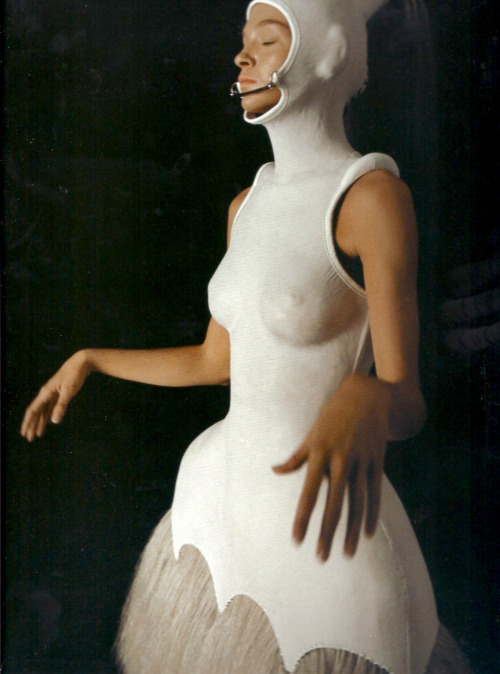
It's impossible to talk about the history of fashion without heavily referencing the iconic Antwerp Six, a young design collective that changed the face of commercial fashion way back in the mid-1980s. These young pioneers were followed a few years later by one of fashion's most elusive vanguards; Martin Margiela established his 'Maison' in 1989 and went on to redefine minimalism and logo culture. His critically-acclaimed collections never featured labels; instead, every piece was hand-finished with four plain white stitches in the place the label should have been. His intimate shows were amongst the first to evoke tears from a crowd of hard-nosed fashion editors, and key pieces such as his 'Tabi' boots toed the line (quite literally) between commercial and experimental, forcing the rest of fashion to catch up. Finally, in 1995, Raf Simons was first introduced to the fashion world as a little-known designer with a new menswear brand focussed around youth culture. Back then, few could have predicted that the designer sending pale, skinny street-cast skateboarders down the runway would become one of the most powerful men in fashion, eventually being chosen as Creative Director of Christian Dior. These designers all have one thing in common; they all studied at the prestigious Royal Academy of Fine Arts in Antwerp, a school which defines Antwerp as a city at the top of any fashion lover's bucket list. I was recently lucky enough to spend a weekend in Antwerp and, between visits to Dries van Noten's flagship store and swigs of Belgian beer, visit the city's ModeMuseum.
Thierry Mugler,'Chimere'

Saturday, 8 February 2014

FASHION x WEARABILITY

One of the most intriguing things about fashion is that it is a word with no real definition. A quick search in the Oxford English Dictionary defines fashion as “a popular or latest style of clothing, hair, decoration or behaviour” – an implication that it is something which is transient as opposed to permanent. However, this is a definition which has been skewed by endless pop-culture re-interpretations, ranging from fashion shows through to fashion blogs. Google ‘fashion blog’ and the results vary wildly – from teen girls modelling their latest Forever 21 ‘hauls’ to in-depth reviews of ‘90s couture and essays on fashion history, these blogs often have little to do with ‘fashion’s’ dictionary definition.


Wednesday, 8 January 2014

ANGELS & DEMONS

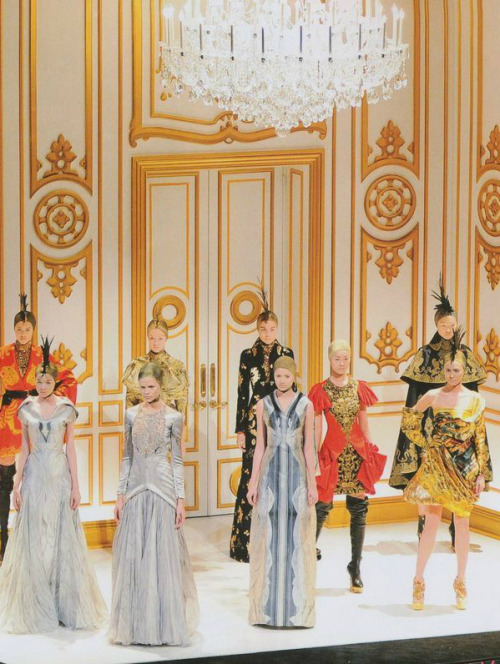
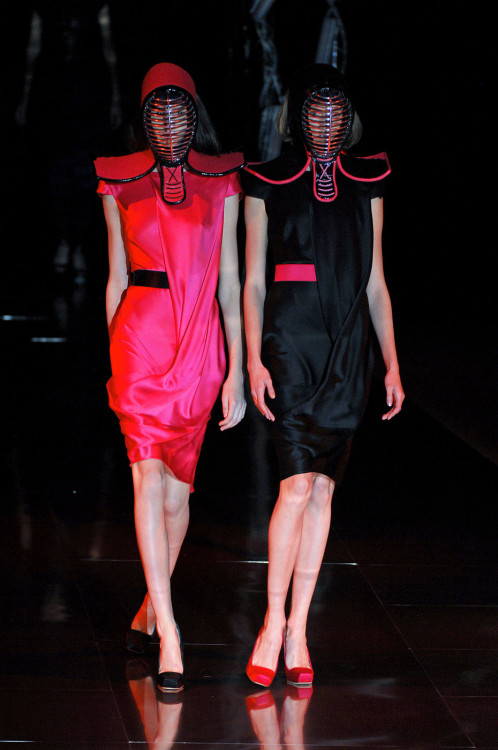
There is dispute as to whether it is this collection (video link here) or ‘Plato’s Atlantis’ that should be classed as McQueen’s last – although S/S 2010 was the last that he completed, this posthumous collection was around 80% complete at the time of the designer’s death. I have chosen to take a further look at it both for reasons of posterity and also because the pieces revealed a more elegant side to the designer’s palette, taking classic works of art and superimposing them onto a series of breathtakingly beautiful garments. It’s perhaps ironic that McQueen became truly fascinated with religion and its concepts of the afterlife just months before his suicide, and although the posthumous collection has no official title it is known as ‘Angels and Demons’ – a title which fits the collection perfectly.

PLATO'S ATLANTIS

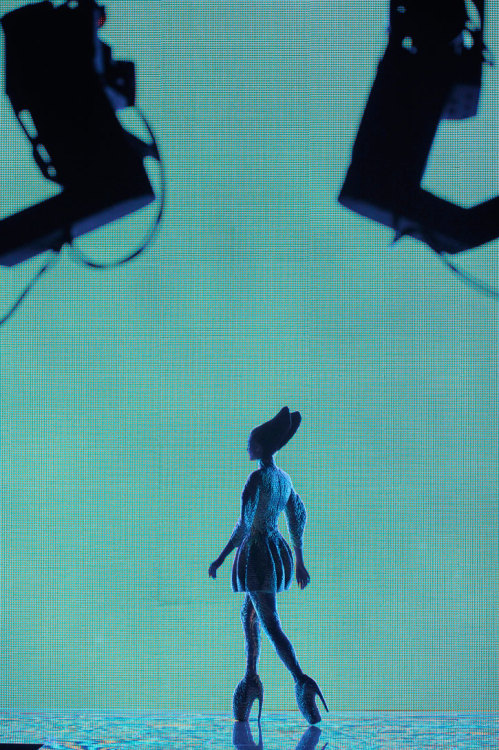
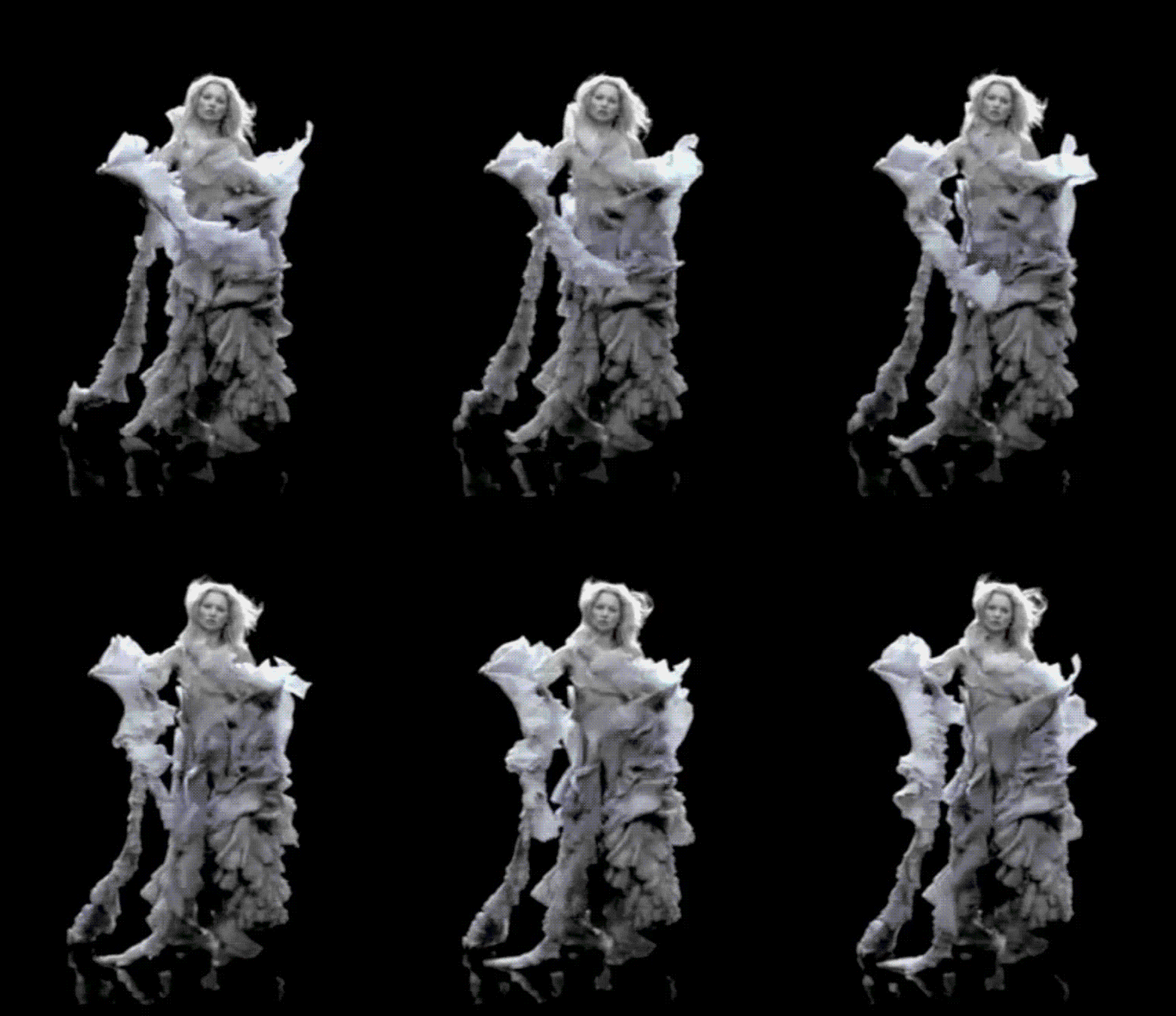
After symbolically collating the last 15 years of his work with his ‘Horn of Plenty’ collection, ‘Plato’s Atlantis’ (which can be seen in full here) saw Alexander McQueen draw a line under his past and move firmly towards the future. Utilising technology to its full potential, the designer announced a collaboration with renowned fashion photographer Nick Knight which would see the entire show streamed live on the photographer’s influential website ‘ShowStudio’ – a move which would take the notoriously exclusive world of the fashion show and smash it apart, broadcasting this usually private event to an audience of millions. It was only when international superstar Lady Gaga tweeted that the show would also debut her new single that excitement reached fever pitch, leading to the servers crashing immediately from overwhelming demand and representing a new peak in the designer’s career.


Tuesday, 7 January 2014

THE HORN OF PLENTY

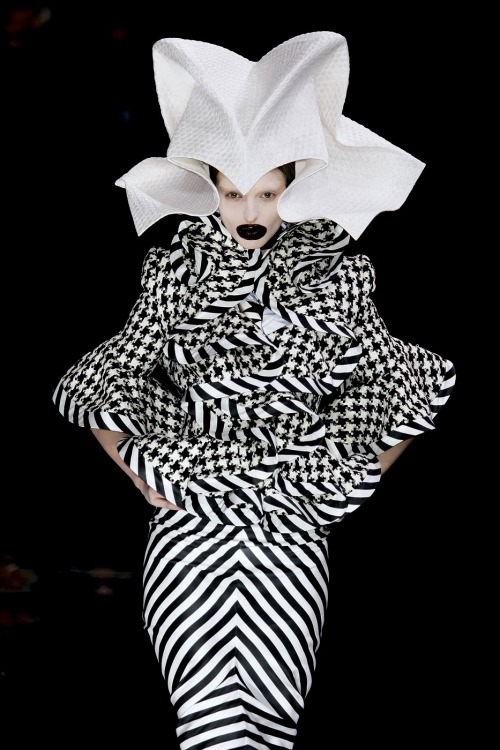
Continuing his exploration of the battle between man and nature, McQueen’s ‘Horn of Plenty’ presentation (which can be seen in full here) was a return to a more brutal aesthetic for the designer. Taking place in a vast industrial wasteland, the show’s towering centrepiece was a scrapheap from which parts had been taken and made into headwear for the harlequin-faced models. The concept behind the set was that of recycling and renewal, a concept illustrated by the fact that props from his previous sets had been taken and spray-painted black in order to populate the scrapheap that dominated the stage. The designer spoke about how he wanted this show to be a retrospective of sorts, one that would mark his 15th anniversary in the fashion industry and enable him to manufacture the image of his legacy – a story which is particularly poignant considering that this would end up being his penultimate complete collection.


NATURAL DIS-TINCTION UN-NATURAL SELECTION

In order to find inspiration for his S/S 2009 collection ‘Natural Dis-Tinction Un-Natural Selection’ (which can be seen in full here), the program notes stated that McQueen had been looking into the works of Darwin and his theory of evolution. This research was evident in the abundance of animal print in the collection as well as the warehouse location of the show which was lined with taxidermy animals ranging from polar bears to tigers. The show appeared to be divided into two halves – one of which depicted a life untouched by man and another which depicted man’s interference with nature, creating an overall commentary on man’s influence on evolution. The theme was not unusual for McQueen, and it is one that he would go on to visually discuss in more detail with his following two collections.


THE GIRL WHO LIVED IN THE TREE

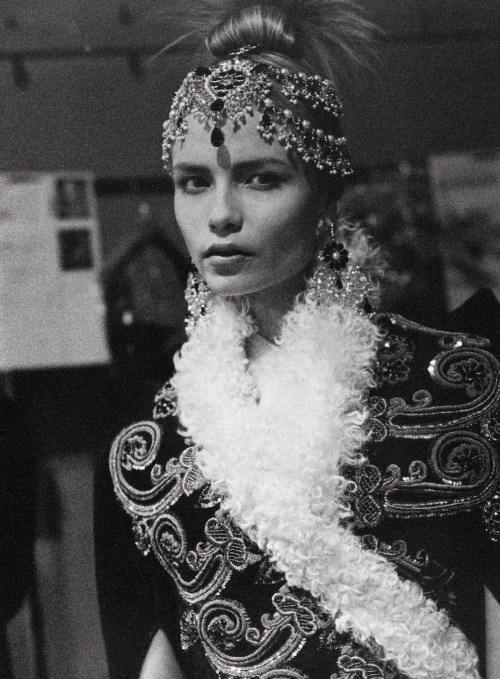
For McQueen’s A/W 2008 presentation ‘The Girl Who Lived in the Tree’ (which can be seen in full here), the designer decided to use his imagination to create an unusual story behind the decadent collection. Speaking of the show, he told of how he would look at the 600-year-old elm tree which stood in his garden and dream that there was a girl dwelling inside it. The story behind this runway presentation would be of that same girl fleeing the darkness of her tree in order to meet her Prince, get married and become a Queen. Set to a soundtrack which combined Indian chants with a classical rendition of ‘Smells like Teen Spirit’, the show was a wonderful example of the designer’s childlike fascination with all things magical and resulted in a series of crinolined princess wandering like nomads around the tulle-wrapped tree which stood centre-stage.

LA DAME BLEUE

Despite collaborating with MAC and launching various diffusion lines, McQueen’s A/W 2007 collection didn’t sell as well as was expected. This created a sense of pressure and expectation around his S/S 2008 presentation, entitled ‘La Dame Bleue’ (which can be seen in full here). The show itself was a collaboration with world-renowned milliner Philip Treacy as the two banded together to pay tribute to the fashion legend that discovered them both, Isabella Blow. Their history began when she attended his graduate show and decided to buy the entire collection - from that moment onwards Blow and McQueen became close friends. She was always the first to champion his designs and he in turn saw her as his muse, leading the designer to claim that he felt “a huge hole in his life” when Blow finally succumbed to a lengthy battle with depression and committed suicide in 2007.

IN MEMORY OF ELIZABETH HOWE

After one of his most romantic collections to date, things quickly turned gothic with McQueen’s following collection ‘In Memory of Elizabeth Howe’ (which can be seen in full here). Once again the designer reached into his own past to pull inspiration for the show, basing it around a distant relative that was executed in the Salem witch trials. The set, with its red crystal pentagram and huge video screens depicting a naked woman writhing around in limbo, set the scene for a sartorial exploration of the history of witchcraft.


SARABANDE

Taking both its name and inspiration from a court dance popular in the Baroque era, McQueen’s ‘Sarabande’ (which can be seen in full here) is a fine example of the designer at his devastatingly romantic best. As usual there were undercurrents of melancholy, but the main focus of this show was simply an orchestra and an array of clothing so detailed that its makings owe more to the process of haute couture than prèt-à-porter.


Monday, 6 January 2014

WIDOWS OF CULLODEN

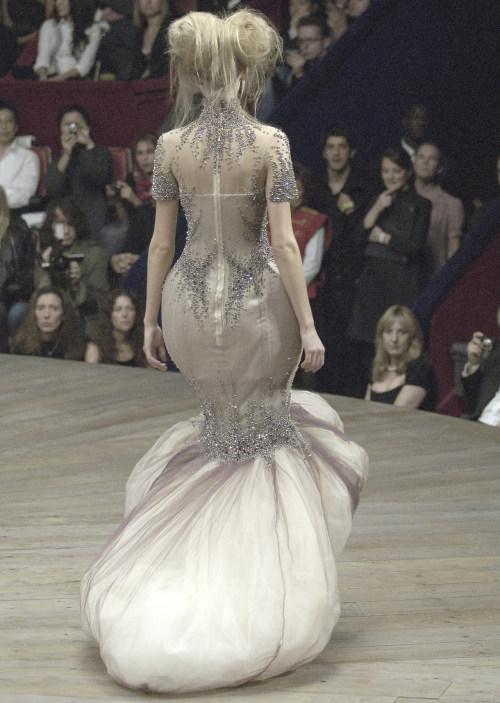
After two overwhelmingly pedestrian runway presentations, McQueen returned to form in spectacular fashion with one of his most critically-acclaimed shows ever. Returning once again to his Scottish roots, ‘The Widows of Culloden’ (which can be seen in full here) tackled similar subjects to his provocative ‘Highland Rape’ collection, albeit with a more romantic eye. Whilst the 1993 McQueen tackled the subject with ferocity and courted controversy, the 2006 McQueen took a softer, more poetic approach. Renowned for his romanticism, this collection is possibly one of the most lyrical of his career, designed to tell the story of the countless widows that resulted from the 1746 Battle of Culloden.


NEPTUNE

Neptune. The mythological Roman God of freshwater and the sea, Neptune was brother to Jupiter and Pluto who collectively watched over the Heavens, Earth and the Underworld. Neptune was also the subject of McQueen’s S/S 2006 collection (which can be seen in full here), one which promised to use the inspiration of Roman mythology to propel the aesthetic for a collection which would, in the designer’s words, ‘bring sexy back’. In interviews he particularly referenced the master of the female body Azzedine Alaia, praising his way of making women look undeniably sexy whilst still maintaining an air of class. The hype was present and the references were exciting, so it is particularly surprising that the collection that followed ‘The Man Who Knew Too Much’ was, in many ways, just as lacklustre as its predecessor.

THE MAN WHO KNEW TOO MUCH

Take Marilyn Monroe, add a little Elvis and finish with a liberal sprinkling of Bardot and you have, essentially, McQueen’s A/W 2005 collection ‘The Man Who Knew Too Much’ (which can be seen in full here). Named after the Hitchcock film, the collection drew upon every ’60s cliché (think glamour girls, the rockers, rockabillies) and teamed it with an equally cliché soundtrack (lots of Elvis.) McQueen is said to have left the show without offering any comment on the collection, which further solidifies the fact that this collection left many with nothing in particular to say.


IT'S ONLY A GAME

For his S/S 2005 collection ‘It’s Only A Game’ (which can be seen in full here), McQueen offered up a collection which is better described as a personal greatest hits than as a stand-alone collection. Although he had always been self-referential (it is always said that the only way to truly become iconic is to repeat imagery), this collection saw him re-interpret a series of his staples by adding a new, feminine touch. It is an example of McQueen’s new, lighter aesthetic which appeared to come after the business was acquired by the Gucci group and, tellingly, after his time working at Givenchy.


PANTHEON AS LECUM

Following one of his most theatrical presentations to date, McQueen introduced ‘Pantheon As Lecum’ (which can be seen in full here) by announcing that he had decided to forgo the theatrics for this collection and focus purely on design. It is true that there’s no huge concept behind his A/W 2004 show (which is rare), but the aesthetics are as gorgeous as ever and the show also, ironically, produced one of the most recognisable runway images of McQueen’s career. The staging was still as spectacular as ever, with the runway becoming an enormous glowing landing pad complete with spaceship. Gigantic video screens projected footage taken from space interspersed with videos of meteors and accompanied by a techno soundtrack – it was instantly clear that McQueen had gone galactic.